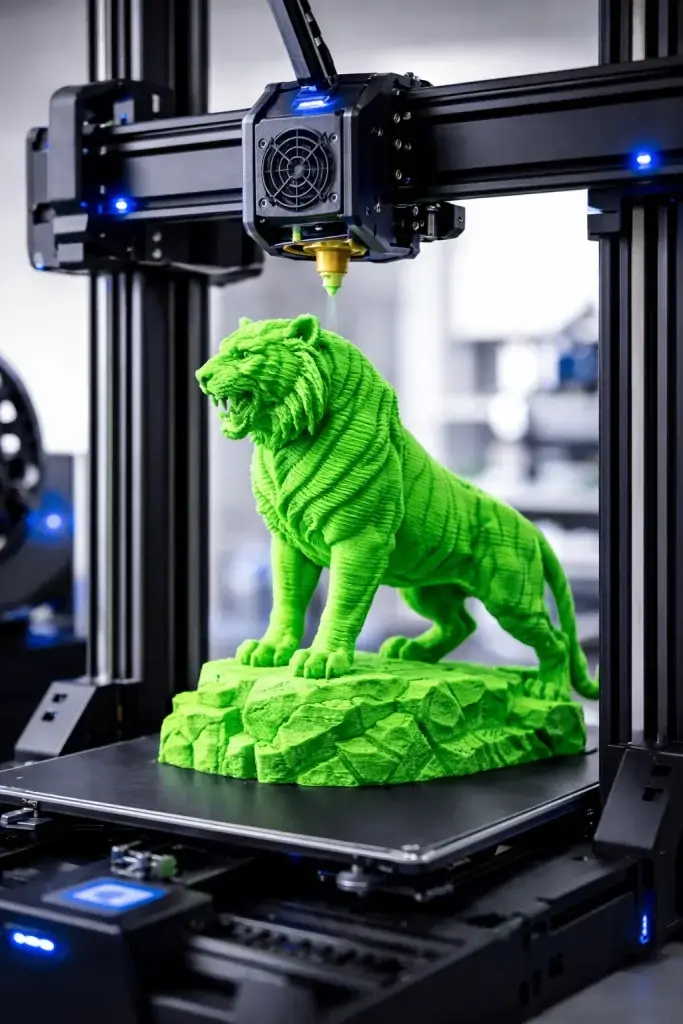
3D printing has become one of the most revolutionary manufacturing technologies of the 21st century. Also known as additive manufacturing, 3D printing allows designers, engineers, and creators to transform digital models into physical objects by building them layer by layer.
Unlike traditional manufacturing methods that cut, drill, or carve material away from a block, 3D printing adds material precisely where it is needed. This makes it possible to create complex shapes, internal structures, and customized products with minimal waste.
Over the last decade, 3D printing has moved far beyond simple prototyping. Today it is widely used in industries such as healthcare, aerospace, automotive, architecture, and jewelry design.
This complete guide explains how 3D printing works, the types of 3D printers available, materials used in additive manufacturing, and the future of this rapidly growing technology.

What is 3D Printing?
3D printing is a manufacturing process where a three-dimensional object is created from a digital file by depositing material layer by layer.
Each layer represents a thin cross-section of the final object. When hundreds or thousands of layers are stacked together, the complete 3D object is formed.
Because the process builds objects gradually, it enables designers to create shapes and geometries that are impossible to produce using traditional machining methods.
This is why additive manufacturing has become essential for rapid prototyping, product development, and customized manufacturing.
How 3D Printing Works
Understanding how 3D printing works requires looking at the full workflow from digital design to finished product.
1. Creating a 3D Model
The process begins with a digital model created using CAD software.
Popular 3D modeling programs include:
Rhino 3D
Fusion 360
Blender
SolidWorks
These tools allow designers to build precise digital models that represent the final object.
For jewelry designers, specialized plugins and tools are often used to create intricate patterns and gemstone settings.
2. Exporting the STL File
After designing the model, the file is exported as an STL file.
STL stands for stereolithography, and it represents the 3D surface using thousands of triangular polygons.
This format is widely supported by almost all 3D printing software.
3. Slicing the Model
Next, the model is processed using slicing software.
A slicer divides the object into thin horizontal layers and converts the model into G-code instructions.
These instructions tell the printer:
where to move
how fast to move
how much material to deposit
Popular slicing software includes:
Cura
PrusaSlicer
Lychee
Chitubox
4. Printing the Object
Once the file is prepared, the printer begins building the object layer by layer.
Each layer bonds with the previous layer until the final object is completed.
Depending on the printer type, this process can take anywhere from a few minutes to several hours.
5. Post-Processing
After printing, additional finishing steps may be required.
These include:
removing support structures
sanding and polishing
UV curing (for resin prints)
painting or coating
Post-processing improves both the appearance and durability of the final print.
Types of 3D Printing Technologies
Several different technologies are used in 3D printing. Each has unique advantages and applications.
FDM (Fused Deposition Modeling)
FDM is the most common type of 3D printing.
It works by heating thermoplastic filament and extruding it through a nozzle.
The melted plastic is deposited layer by layer until the object is complete.
Advantages of FDM
affordable printers
widely available materials
good for functional prototypes
Common Materials
PLA
ABS
PETG
Nylon
TPU
FDM printers are commonly used by hobbyists, engineers, and small businesses.
SLA (Stereolithography)
SLA printing uses UV light to cure liquid resin into solid layers.
This technology produces extremely detailed prints with smooth surfaces.
Because of its precision, SLA printing is widely used for:
jewelry models
dental molds
miniatures
product prototypes
SLS (Selective Laser Sintering)
SLS printing uses a laser to fuse powdered material such as nylon.
Unlike other methods, SLS printers do not require support structures.
This allows the production of complex mechanical parts and functional prototypes.
SLS technology is widely used in industrial manufacturing.
Materials Used in 3D Printing
Different printing technologies require different materials.
Plastic Filaments
Plastic filaments are the most common materials used in FDM printers.
PLA is popular because it is easy to print and environmentally friendly.
ABS is stronger and more heat resistant, making it suitable for mechanical parts.
PETG offers a balance between strength and flexibility.
Resin Materials
Resin printing uses photopolymer liquids that harden when exposed to UV light.
Specialized resins include:
castable resin for jewelry
dental resin for medical models
flexible resin for rubber-like parts
Resin printers are known for their exceptional detail and smooth finishes.
Metal Materials
Metal 3D printing has become increasingly important in industries that require strong, lightweight components.
Common materials include:
titanium
stainless steel
aluminum
Metal additive manufacturing is widely used in aerospace and medical implants.
Advantages of 3D Printing
3D printing offers many benefits compared to traditional manufacturing.
Rapid Prototyping
Designers can quickly produce prototypes and test ideas before committing to expensive manufacturing processes.
Complex Geometry
Additive manufacturing enables the creation of shapes that are impossible with traditional methods.
Reduced Waste
Because material is only added where necessary, 3D printing generates less waste.
Customization
Products can be easily customized without increasing production complexity.
Faster Development
Companies can reduce product development cycles and bring innovations to market faster.
Applications of 3D Printing
The applications of 3D printing are expanding rapidly across many industries.
Healthcare
Doctors use 3D printing to create:
prosthetic limbs
surgical guides
dental aligners
anatomical models
These tools help improve surgical planning and patient outcomes.
Aerospace
Aerospace companies use 3D printing to produce lightweight aircraft components.
Reducing weight improves fuel efficiency and overall performance.
Automotive Industry
Car manufacturers use additive manufacturing for:
rapid prototyping
tooling
lightweight structural components
Architecture
Architects create detailed building models that help visualize designs before construction.
Jewelry Design
3D printing has transformed modern jewelry design.
Designers can produce highly detailed wax models for casting gold and silver jewelry.
This process allows intricate designs to be produced quickly and accurately.
The Future of 3D Printing
The future of additive manufacturing is incredibly exciting.
Researchers and engineers are developing new technologies that could transform entire industries.
Some emerging innovations include:
bioprinting human organs
3D printed houses
AI-generated product designs
4D printing materials that change shape
As printers become faster and materials more advanced, 3D printing will continue to reshape global manufacturing.
Conclusion
3D printing has evolved into one of the most important manufacturing technologies of the modern era. By enabling rapid prototyping, complex designs, and efficient production, additive manufacturing is transforming industries worldwide.
From healthcare and aerospace to jewelry design and architecture, the possibilities of 3D printing continue to expand.
For designers, engineers, and entrepreneurs, understanding this technology opens the door to innovation, creativity, and new business opportunities.
Frequently Asked Questions
What is 3D printing?
3D printing is a manufacturing process that creates objects layer by layer from a digital model.
What materials are used in 3D printing?
Common materials include PLA, ABS, resin, nylon, and metal powders.
Which industries use 3D printing?
Industries such as healthcare, aerospace, automotive, architecture, and jewelry manufacturing use 3D printing.